
Have you ever wondered why some web sites appear on the first page of Google and others remain completely hidden? Or perhaps you have visited a page that seemed to understand your needs, making it so easy to get to the next step. Isn’t that amazing? Well, there is a reason why that is and it all boils down to how the words on those pages are written.
This is possible through two large styles of writing. One of them is referred to as SEO copywriting. Those are the types of writings that make websites visible to the search engines. The other one is conversion copywriting. It involves making people act such as clicking, subscribing or purchasing. You may think these two are completely unrelated things, but here is the thrilling part: when you bring them together, something really powerful happens. It may appear initially that you must choose either one. Should you write so Google notices you? Or should you focus on convincing real people to do something once they land on your page? However, the fact is, you do not need to make a choice. The truth is that real magic occurs when you combine them.
And that is what we will discuss in this blog. We are going to get into why SEO copy is so important, how conversion copy can convert a visitor to a customer and why the smartest marketers are utilizing both simultaneously.
Read: How Clinic Management Software Improves Appointment Scheduling Efficiency
1. Understanding SEO Copywriting:
Having taken a peek into the realm of smart copywriting, it is time to explore our first key player: SEO copywriting. In essence SEO copywriting is all about making your content discoverable. It is the science of appearing when a question or a need is typed into a search engine. With Google processing billions of searches on a daily basis alone, appearing on the appropriate time, and in the right context can be a huge game-changer in terms of your visibility.
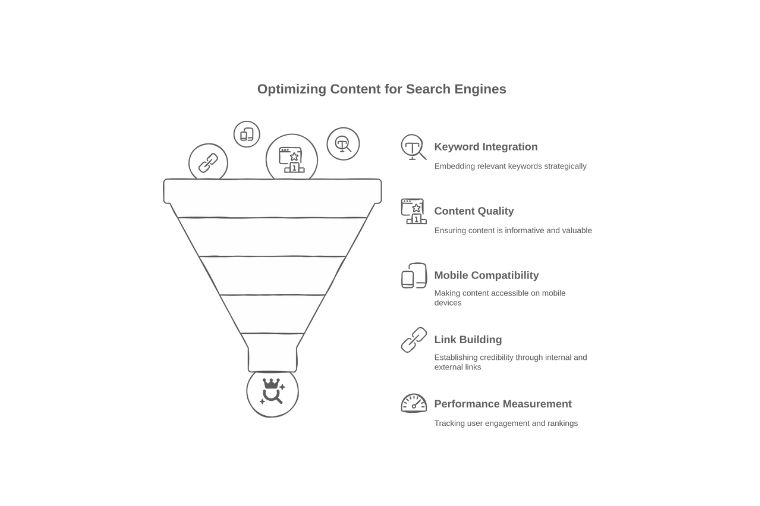
This approach is a blend of writing and strategy. You are not only writing for people, you are also communicating with the search engines about the purpose of your page through use of relevant keywords. When you embed these keywords in strategic areas, such as your title, initial lines, headings, and even in your image files, your content has a higher probability of being interpreted and presented by search engines.
However, the inclusion of keywords is not sufficient. Your content must be helpful in the real sense. In other words, it involves the creation of well-written content that is informational, addresses actual questions, and can provide value. Google cares about whether your page is contributing to the readers or just filling up the fluff. The higher your depth and quality of content, the greater is your chance of ranking well. In addition to this, SEO copywriting also takes into account the way in which people visit your site.
The fact that most users are reading with their phones makes it important to have mobile compatible pages. It implies concise, scannable paragraphs, readable fonts, and uncluttered layouts that attract readers. When the content on your page is not readable on a small screen people drop off, and that can affect your performance.
Another key ingredient is how well your content is connected. The more reputable websites share links to your pages, the more credible your existence in the eyes of the search engines. Simultaneously internal hyperlinks between your own pages can help navigate your visitors as well as the search crawlers around the site. And it does not stop when you publish. The key aspect of SEO copywriting is also based on measurement. Keeping track of what people are doing with your content, where it is ranking, how long they are staying there, and what people are clicking along the way can help you to learn and grow.
For example, imagine that you are a SaaS company that offers services to remote teams; To succeed, you need to make sure you are available when the exact search term pops up. You smartly use those search terms, write a clear and useful guide, make it mobile-friendly and perhaps link to the free trial. It is a creative precision, and when it all falls into place, it opens doors to grow and discover.
2. Understanding Conversion Copywriting
In the knowledge that SEO copywriting assists people in finding your site, the most exciting part now is to investigate what happens after people find your site. The key is to get attention after all. It is all about the next step, visitors take. And here is where conversion copywriting comes to the rescue. It is like having a friendly companion on the page, one who can talk to every person, address their concerns, and guide them in the right pathway. It could be the headline that leads to registration, a sales page, or a download button; this type of writing is intended to drive action.
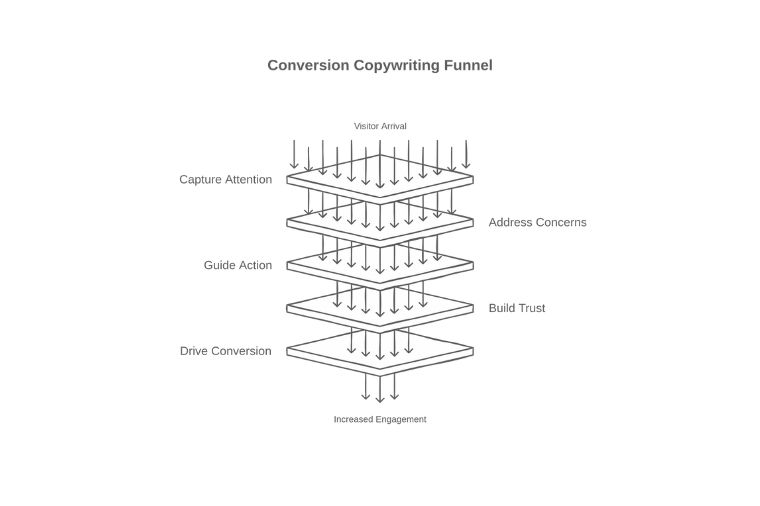
Conversion copywriting is effective because people are well understood. Great conversion writers take time to get to know the audience, including what they struggle with, what they dream of, and what is stopping them in deciding. That knowledge assists in developing a message that sounds more personal and clear. The Rule of One is one of the most helpful in this case. It implies making each piece of copy directed at a single individual, single promise, single idea, and single action. When all of this is centered, then the reader can understand and be confident about what to do next. The most important part is clarity. A simple, specific, and direct copy is the best. Even the slightest variants of a call to action, such as using the phrase Start your free trial instead of Submit, can be significant since it appeals to what one really wants.
Another important part of the puzzle is trust. People become more comfortable when they see actual reviews, evidence of success, or even Awards. And just as with SEO, conversion copywriting is never a one-time thing. It is based on learning, which works by updating the messages, the layouts, or the buttons. One of the best instances is the example of a tech conference that changed the landing page to be friendlier to its visitors. With the value being more transparent and the message simplified, in only a few weeks later they experienced an increase of 25 percent in engagement and 33 percent in sign-ups. It demonstrates the strength of the right words used with a clear understanding of how they can resonate with people and lead them to action.
3. Where SEO and Conversion Copy Converge
We have already discussed how both SEO copy and conversion copy assist people to find your site and take action by prompting them to act. Here is the exciting part. What would be the case when the two approaches would yield best results when applied simultaneously? Although they may appear different initially, both are created to assist the actual individuals.
One of the best places where they converge is a robust introduction. It must immediately attract attention. When it does not, people go and search engines observe. The same is the case with headlines. Apart from helping your page turn up in the search, it also promotes clicks by addressing the needs of the reader directly.
Understanding the audience is very important as far as both SEO and conversion copy are concerned. Having an understanding of what people search and what resonates with people so much that they feel their reality, your content will be easier to locate and keep them engaged. The speed and design of your page even matters here. Clean, quick layout will make readers stay longer, and will benefit your site ranking. As an example, a fitness app page with beneficial keywords, such as workout advice, but also friendly and clear might rank and convert. This type of writing fulfills both of those tasks simultaneously, resulting in an enhanced experience overall.
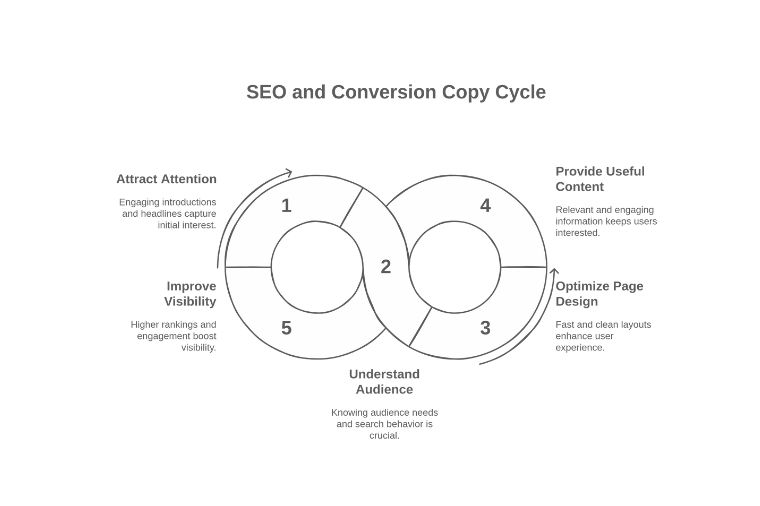
When SEO and conversion copy work together, each one strengthens the other. The more useful and pertinent the information you present, the longer visitors will stay. The longer they remain, the better your content performs. It forms a cycle where visibility and engagement complement each other. One should not see SEO and conversion copy as two distinct routes: merging them is the bright decision. One attracts people and the other puts them in motion. The combination of the two can be a force of multiplied growth when they are at work together.
4. Distinctive Strengths: When Each Shines Individually
With the ideas of how conversion copy and SEO can reinforce each other out of the way, it is time to take a closer look at what exactly makes each of them so very strong in its own right. Knowing when to deal with either one rather than the other can mean a world of difference, particularly when you know what you want to achieve with your business.
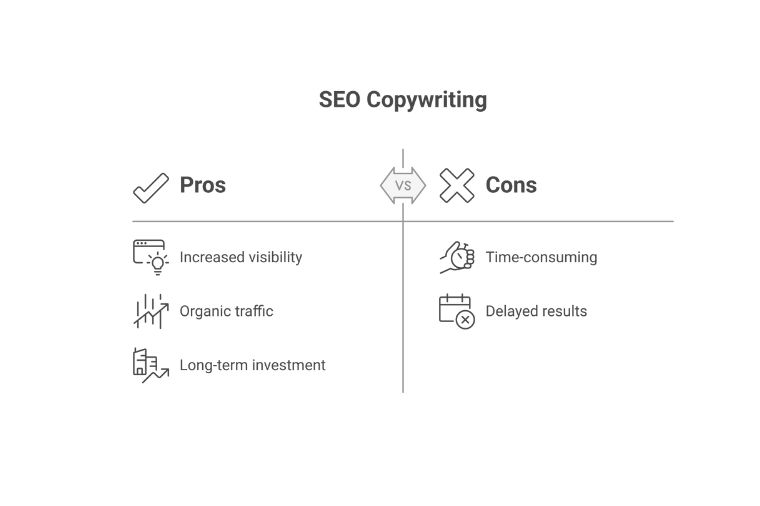
SEO copywriting is great when you want to be visible. It primarily assists its clients in achieving better results when it comes to ranking content in different search engines so that customers can easily locate their online business profile. Google, YouTube, App Store and Amazon are just some of the platforms where content may appear at the right time in the right place through the application of SEO. Whenever companies use keywords and organize the content strategically, they have a chance to create a solid online presence and receive a constant flow of organic traffic in the long run. SEO requires time however. It tends to perform the best as a long term investment, the returns on which accumulate within six to twelve months.
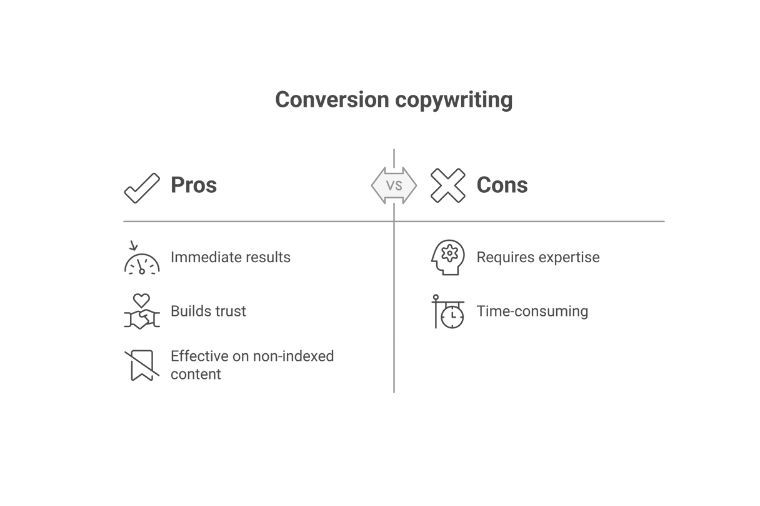
Conversion copywriting however is all about action. It is not about finding it, but rather convincing people already found their way there. With the help of research, psychology, and emotional thinking, such writing can make the readers easily trust a brand and make another step, be it purchase, newsletter subscription, or a resource download. It works particularly well on content that is not indexed and crawled by search engines and that includes sales pages, paid advertisements, social posts, or email marketing. Unlike SEO, conversion copy may demonstrate immediate effects. In fact, in certain instances simply modifying the structure or the message of a landing page has resulted in a 50 percent conversion gain within a span of 6 weeks.
Where to focus usually depends on your strategy and stage. Other marketers suggest making conversion copy a starting-off point to help develop your brand voice and message before spending money on SEO. Some would rather get the reach by means of the utilization of SEO initially and conversion copy later on. Both are correct. What counts is suitability of the approach to the moment. When you have the traffic but not the sales you need then conversion copy is your best friend. In case you are invisible on the internet, SEO is the in. The choice can be dictated by even the style of the writer. Individuals who are fond of narrative might be more inclined to conversion whereas people who love structure and research would incline towards SEO.
5. The Winning Strategy
Up to this point, we have discussed how both SEO and conversion copywriting possess their own strengths. However, the real question is still there. What are the applications of the two that have long-term effects? That is where the real magic starts. Combining science of visibility with art of action will make up a fully-fledged strategy that will go further than bringing visitors. It makes them feel welcome, involved and active.
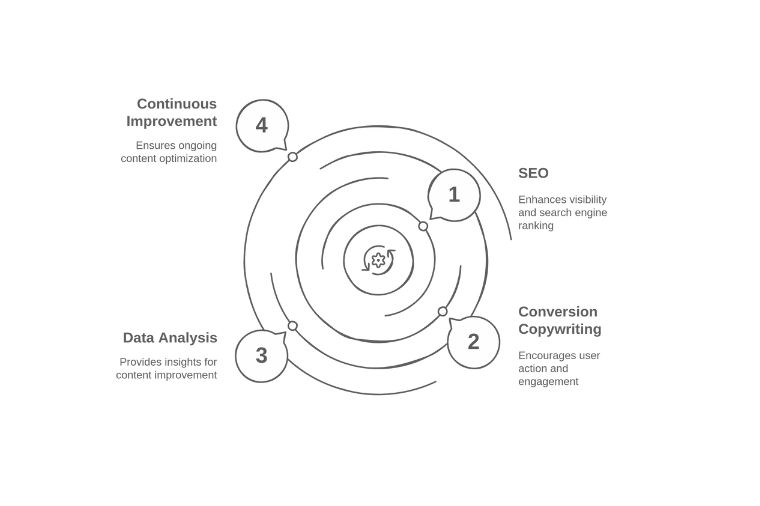
- Start by Knowing When to Use What
Practically, to achieve the best outcomes, it is advisable to apply both SEO and conversion copywriting but not necessarily side by side simultaneously in perfect proportions. SEO is the way to go, in case you want to be discovered by those who are searching. Conversion copywriting, on the other hand, is your bread and butter when you have visitors and need those people to sign up, purchase or contact you. Knowing when to switch or how to get a combined middle ground is where one should start in the development of a smart and multi-faceted content strategy. - Build a System That Never Stops Improving
Practically, to achieve the best outcomes, it is advisable to apply both SEO and conversion copywriting but not necessarily side by side simultaneously in perfect proportions. SEO is the way to go, in case you want to be discovered by those who are searching. Conversion copywriting, on the other hand, is your bread and butter when you have visitors and need those people to sign up, purchase or contact you. Knowing when to switch or how to get a combined middle ground is where one should start in the development of a smart and multi-faceted content strategy. - Trust the Data, Not Just Best Practices
No one can have the most ideal rulebook that fits all. The most important thing is what the data can tell you about your audience. This is where Conversion Rate Optimization tools come in. Web personalization platforms (such as these) can provide you with a clear idea of how users navigate your content. They give an understanding of what attracts attention, drops off, and what people do. When combined with SEO knowledge, these tools will provide you with a complete image of what is working with your content and what should be altered. CRO tools are not only handy, but they are also required to make sure you get confident and creative about your content.
Conclusion
SEO copywriting and conversion copywriting might seem distinct at face value but work most effectively when combined. SEO assists in the discovery of content by making it countable in search engines and drawing in organic visitors. Conversion copywriting then goes further and applies simple, compelling language to get action. One attracts people and the other drives them. Combined, they create a solid basis of significant interaction and quantifiable outcomes.
To succeed in modern marketing and business management, the best strategy is no longer to make a choice between the two but to integrate their best qualities. Incorporating visibility and persuasion, one can develop the content that is not only equally reachable by the correct audience but also makes them act in the intended way.
Author’s Bio
Vidhatanand is the Founder and CEO of Fragmatic, a web personalization platform for B2B businesses. He specializes in advancing AI-driven personalization and is passionate about creating technologies that help businesses deliver meaningful digital experiences.
